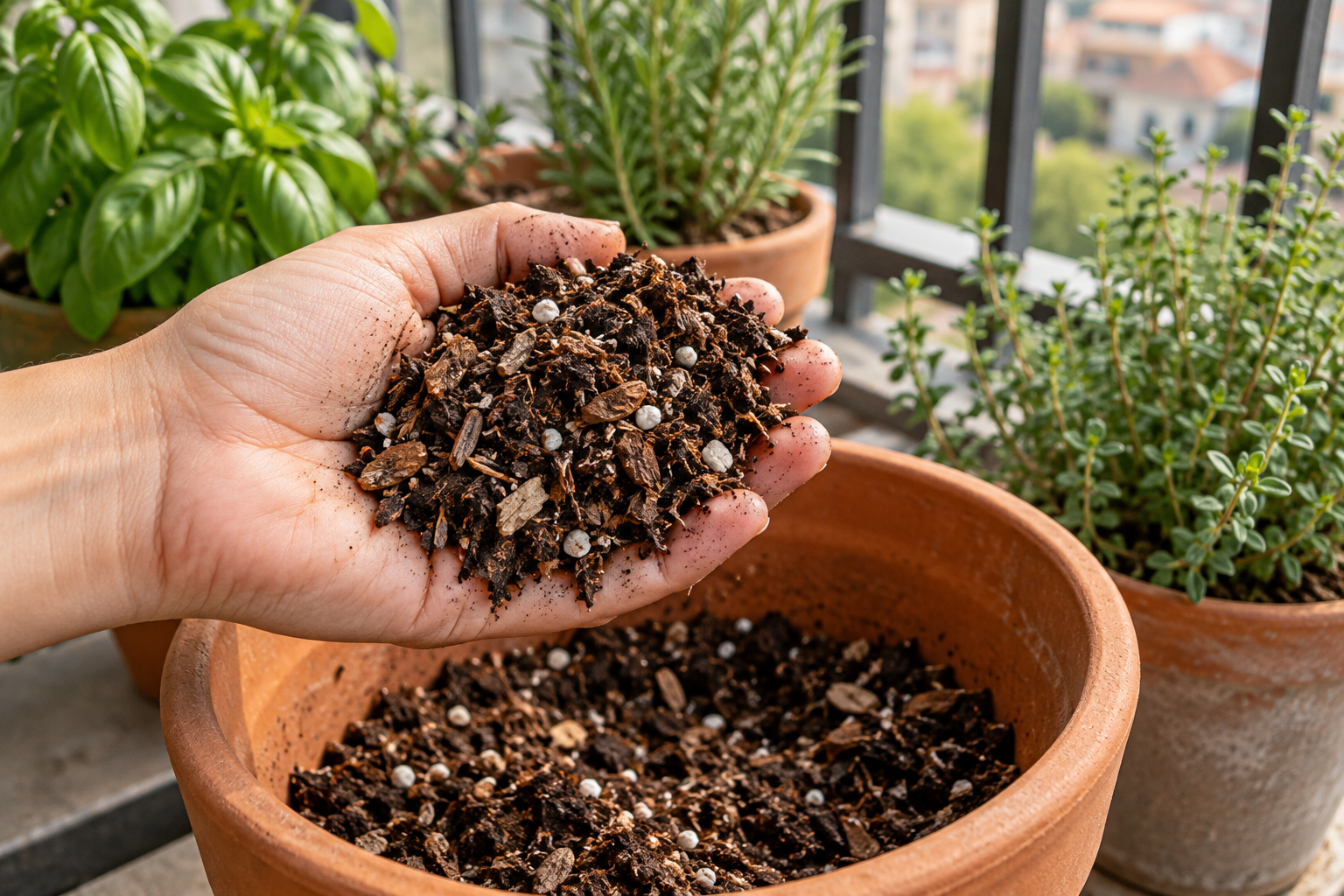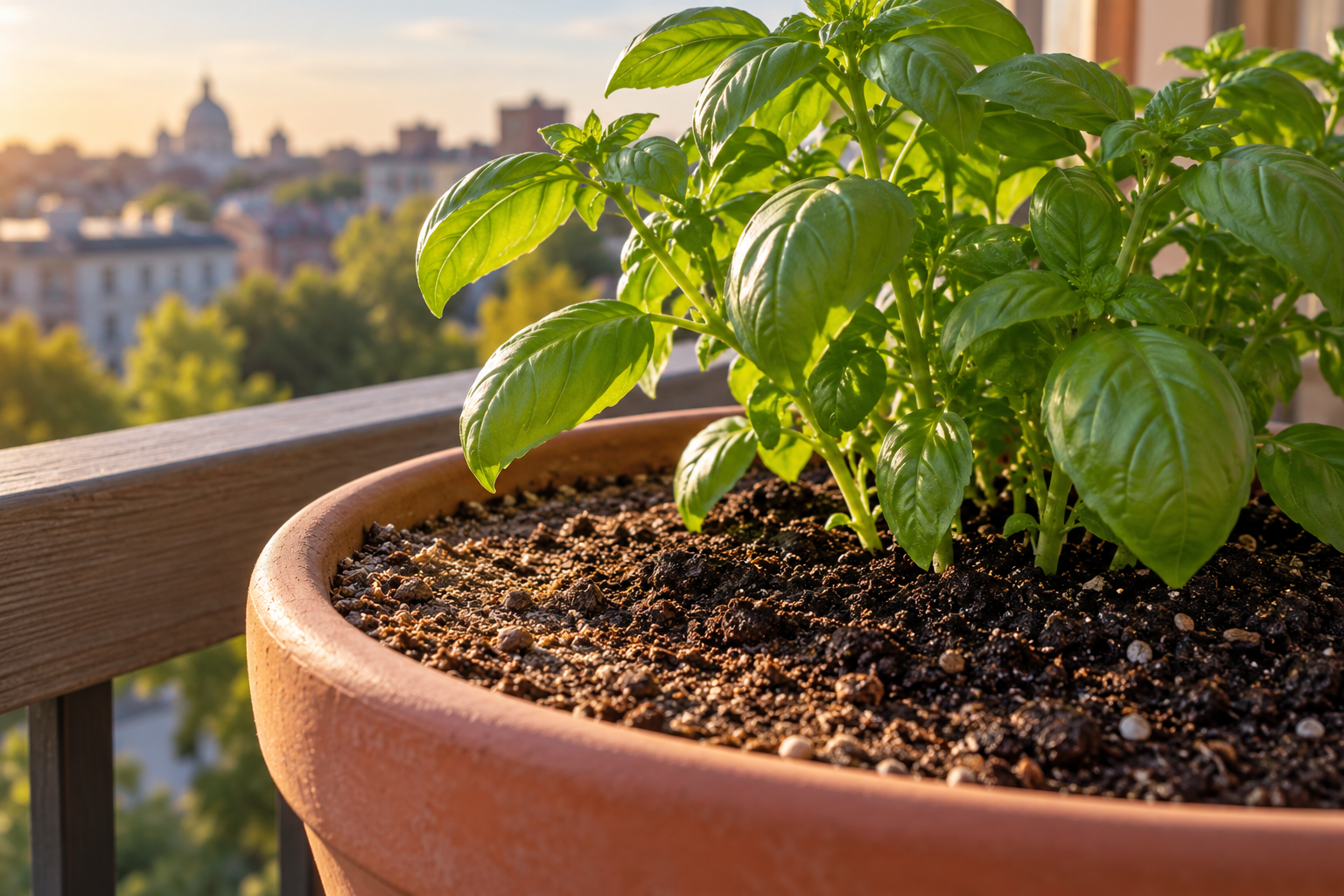
A pot can look thirsty at the top and still hold a surprising amount of water below. The surface turns pale, perhaps even crusty. A finger comes away dusty. Yet a few centimetres deeper the mix is cool and damp. Water does not leave a container as a single, level tide; its route depends on where it began, which pores hold it, where the roots are, and which parts of the pot meet moving air and sun.
That matters on a balcony, where a plant has only the volume inside its container to draw from. A dry patch is information, but it is not a verdict on the whole root zone. The useful question is which part of the mix is dry, and why?
The pot starts with a gradient
After a thorough watering, surplus water drains from the holes. Some remains in the spaces between particles because those spaces can hold it against gravity. The lower part of a free-draining pot generally has more water, and less air, than the upper part. The exact pattern changes with the height of the container and the structure of the mix. In one experiment with peat and perlite, researchers followed five stages of drying in planted and unplanted containers; the unplanted columns remained wetter toward the bottom as they dried. That measured profile is a better picture than the idea of a pot simply becoming dry from top to bottom at a uniform rate.
The difference can survive a change of recipe. In a separate pine-bark and peat experiment, adding peat increased the water held by the bulk mix, while calculated water content near the top of a tall test column remained similar across the mixes. The study concerned nursery substrates and weed emergence, not balcony herbs. Its narrower lesson is useful here: a surface reading need not represent the water held throughout a container.
An especially shallow pot complicates the picture because a greater share of its mix sits close to the wet lower region after drainage. A tall pot of the same material can have a larger, airier upper region. Neither shape is automatically better for every plant; the proportions change the water and air its roots encounter.
Water has several ways out
The exposed surface loses water to the air. At first, moisture can travel through connected pores toward that surface and evaporate. As a peat-based mix dries, that route becomes less effective. Juha Heiskanen measured a steep fall in hydraulic conductivity during drying, as well as substantial shrinkage in the peat media he tested. In plain terms, water still present in one part of the pot may move too slowly through a very dry region to make that region feel moist again. Those measurements came from specific peat mixes; they do not give a universal drying timetable.
The plant removes water by another route. Roots take it from the places they reach, and leaves release much of it to the air. In the peat-and-perlite experiment, planted Ficus benjamina containers did not follow the same vertical drying pattern as unplanted ones. Fine roots were concentrated in particular layers, and water losses were largest in the two lowest segments. The authors' comparison shows why a pot's pattern changes as a plant fills it: the roots become part of the plumbing.
The wall can matter too. In multi-site nursery trials, porous fabric, wood-pulp and coir-fibre containers lost more water through their sides than conventional plastic containers, while some of those porous containers kept the mix cooler. Those were gallon-sized nursery pots growing shrubs, not a test of every ceramic or balcony planter. Still, the trade-off is clear: a wall that lets water escape may cool the root zone while increasing water use.
Sunlight on the wall adds another variable. A Spanish greenhouse experiment found greater substrate evaporation from black plastic pots than from white or terracotta-coloured plastic pots. But a different Brazilian pot experiment, under shade cloth and using another medium, found no effect of colour on temperature or water lost. Pot colour alone is therefore a poor watering schedule. Exposure, material, size and mix all belong in the observation.
The next watering may not erase the dry patch
Drying also changes how readily a mix accepts water. In a controlled rehydration experiment, white peat became harder to wet as it dried more intensely, while wood fibre recovered its water retention under the tested conditions. Surface drip watering and watering from below gave different uptake patterns in the peat. That finding does not mean every bagged mix becomes water-repellent. It means a fast pour onto a very dry peat-rich pot may tell you little about how much water reached the middle.
Peat can shrink as it dries. Imaging and moisture tests of three Sphagnum-based media recorded shrinkage and changes in pore structure during drying and wetting cycles; the samples recovered most of their height and imaged porosity when rewetted. If a dried mix has pulled away from the wall, water running down that gap is a plausible route, though the imaging study did not test a balcony pot's side gap directly. Water at a drainage hole is evidence that water found a path through. It is not, by itself, proof that the whole root ball is wet.
Read the pot in more than one place
Start with a reference you can repeat. After watering a pot and letting it drain, lift it and notice its weight. Check the mix a little below the surface near the stem and near the rim, without repeatedly disturbing roots. Over the following days, compare both the feel at those depths and the weight of the same pot. Weight reflects water lost from the container as a whole; a small dry patch or a wet lower layer needs a local check. A moisture meter can help with repeated comparisons, but a probe samples only where it sits. Even research instruments require interpretation: in tests of peat-based mixes, a capacitance probe's readings were sensitive to salinity and needed calibration.
If the surface is dry while the pot remains heavy and damp deeper down, another generous watering may leave the lower roots with little air. If the pot feels light, the deeper mix is dry, and a quick pour rushes out, slow the application and check whether the interior actually takes up water. A small amount applied, allowed to soak in, then followed by more can reveal a great deal. Let excess drain; do not turn an effort to rewet the mix into permanent standing water.
No single finger test, pot colour or clock can replace that sequence. The surface tells you about the surface. The weight tells you about the whole container. The deeper check tells you what the roots may be meeting today. Read them together, and uneven drying becomes something you can understand before you try to fix it.

A thought worth keeping?